Showing posts with label hookah. Show all posts

Friday, November 15, 2013

Creating Shisha - The Tobacco

My real appreciation of hookah has come down to tobacco.  When I first started smoking shisha, I loved the big fruity flavors, the classic double apple, and the massive clouds.  Somewhere along the line that took an abrupt turn and I find myself smoking unflavored shisha 75% of the time.  This led me to the idea that instead of taking a semi-flavorless tobacco and giving it different flavors, why not make a variety of tobaccos with the intent of experiencing the nuances of the leaf itself.

That's not to say that I don't still love my flavors.  Two of my favorites that I make are a banana/clove blend and a peppermint/blueberry blend.  I smoke them all the time and I love the experience.  And I'm also still addicted to Al Fakher's Double Apple with Mint.

But for me, the leaf is where it's at.  Here are a few that we use to make our shisha.  Each has their very own personality, look, and feel.  Each requires a different cut based on the build of the leaf which makes for its own challenge.  But the enjoyment is in the ritual, yes?

Canadian Virginia Flue Cured

The mainstay tobacco that we use for our flavored blends is the Virginia Flue Cured.  Light in color and light in flavor, it is a perfect leaf for flavoring.  And luckily it is one of the easier leafs to cut.  Being that everything we do is hand-cut, the process is very time consuming and tough on the hands.  Also known as Brightleaf Tobacco, it is a very smooth smoke.

The cut that we put on this leaf is done by rolling the tobacco into a bunch and cross cutting the roll.  This makes for a long, thick shisha leaf and gives a great amount of surface area for flavor to hold on to.  We are also able to separate the stems very cleanly from this leaf, so what you get is a 99% stem free shisha with a nice even cut.

American Virginia Flue Cured


Much fuller and richer in flavor that the Canadian Flue Cured, the American Virginia Flue Cured has a lot more depth and seemingly a greater buzz than the Canadian.  This is also a drier leaf with smaller stems that are reasonably usable and cut for the blend.  This makes for a different texture in the package than the Canadian.

The cut is also made slightly different because with the drier nature of the leaf, the cuts tend to be much smaller and random than that of the Canadian blends.  It also makes for a drier feel in the hands when being packed.

We only use the American VFC for unflavored blends.  It is a 100% natural Gallberry honey blend that we buy at a local farm.  When burning this blend, you can also get a beautiful whisp of the honey burning on the aroma.  The richness of the leaf is perfect for the light and flavorful honey mix as the two make a combination that is unmistakable once you've had a few bowls of it.

Connecticut Broad Leaf 

This is a big-punch leaf.  A very strong, but smooth and very flavorful leaf.  This is one that you don't want to smoke on for too long. lest you have a massive buzz.

A very elastic leaf, this one.  When we cut it, it takes much more effort and the leaf wants to bind up.  Not that it's not worth it.  This leaf is used in making the Magdy Louis blend, which is named after a man who I greatly respect.

This leaf is also special to me for another reason.  The punch this one packs, coupled with the massive flavor it throws off reminds me of smoking the difficult-to-find Tombac while I was in Egypt.  The Tombac was a man's-man smoke and I wanted to replicate that as closely as I could with this leaf.    Trying to replicate that experience requires a lot of heft.  Therefore, we make the Magdy Louis with 100% molasses and leave the honey out.  The rich molasses flavor is the only thing that can stand up to this big leaf and I must suggest smoking this blend with the same care as when smoking Tombac.  I woould recommend short, light puffs on this one as opposed to the big shisha drags you're probably used to.

Brazilian Habano Viso

This is a new leaf for us.  I have one pound sitting waiting for a glycerine injection as we speak.  I'm pretty excited about this leaf as everything I've read leads to me thinking that it is going to be very flavorful.  On this run, I am just blending it with Gallberry honey to see the nature of what the lead provides. It is also a very expensive tobacco, making the prospect somewhat nerve-racking.

When I received the leaf, the aroma was jumping out of the bag.  Described by experts as having a leathery, chocolaty, peppery aroma, I could definitely see the leather before I even opened the bag.  The texture on the leaf was also leathery and very easy to cut, with the perfect level of moisture for our needs.  

This particular leaf is apparently native to Cuba, but the seeds for this blend were planted and grown in Brazil.  From what I have read, it still keeps much of the characteristic of its Cuban cousin.

When we do get a good clutch on what this leaf is all about, I suspect it's going to be a candidate for a honey blend, but I'm leaning toward an orange blossom honey, which is also harvested 100% natural and local to me.  The flavors sound like they'd be a nice match, so this month of curing is going to see exceptionally long.
If there are any questions in reference to our leaves or what is used in which blends, feel free to ask.  We will also be moving into some more exotic leaves as time goes by to get deeper into the idea of unflavored shisha production.  Cheers to all of you and happy smoking!


Sunday, June 30, 2013

The Renegade Reps Hookah Charity

It is a strong feeling that I have that any business should be accompanied by a cause that is strictly for good, for the betterment of someone else.  The influence and wide net cast by conducting business just presents too many great opportunities to do so that it is a shame to allow it to pass.  Thus, ever since the Renegade Reps Hookah venture has come to be, I have been trying to find a charitable cause that would best represent what we do and get the most bang for the recipient's buck.  It was on this great trip to Egypt that I ran across that opportunity.

The opportunity that we found was the Abu Elhagag Festival, an annual event that brings in peoples from all surrounding areas to experience community, music, dances, horse races, and a parade through the streets.  What struck me most about the event was a giant tent that was constructed for travelers.  Within this tent, those who do not have enough for lodging are free to stay, while the local families bring food for them to eat.  This assures that every person, whether poor or rich, can experience the festival.

A fascinating story of Abu Elhagag himself and the mosque (see above) that bears his name can be found by following this link: http://en.wikipedia.org/wiki/Abu_Haggag_Mosque.  As you can see, the mosque (which was initially a church) was accidentally built atop the ruins of the Luxor Temple.  Due to this, the mosque appears embedded inside the ruins.

What made the idea for this cause tip for me was when a wagon full of kids pulled up and my brother had suggested that we buy them all hats from one of the local vendors.  We did and the kids were happy.  The most affecting part was seeing the thankfulness in the father when he came over to give us his blessing.  It didn't break the bank for us, but it clarified for me how appreciative the locals are for what they have.

So, we came up with this idea:  Just raise money and just give it to the poor in Luxor.  A very simple idea, but the gaff is in the simplicity.  This way, we can make sure that 100% of every dime donated can get directly into the hands of the poor.  It's that easy.  We will be there to provide, hand-to-hand, the funds we raise here in the States.

And here is how we're gonna raise the money:

I am finding select locations every week to rent hookahs out to the public.  Instead of paying for rental, we will simply take a donation for the cause.  The cause, which we are going to call Elhagag Festival Fundraiser, will be posted on Facebook each week where we will be and at what times.  As stated before, EVERY PENNY will go directly into the hands of the poor.  ALL COSTS associated will be absorbed by Renegade Reps.  It's a no-lose situation.

And the benefit is two-fold.  If anyone has been curious about smoking hookah, but is afraid of the general cost of rental or purchase, you can rent one at a cost that you feel comfortable with.  This way, you can see if you love the world of hookah or if it is just not for you.

If you'd like more information and would like to keep up with where we will be, just LIKE the Renegade Reps Hookah Facebook page and watch for updates.  Cheers!


Monday, June 24, 2013

Another Trip to Luxor - Part 2

After a delightful night of smoking some double apple on the eternal Nile River and spending some quality time with my brother, it was time to get moving on to being tourists.

Ahmed and our guide, Tamer Ibrahim picked us up at 10:00 am and we got underway to the West Bank.  Today was a day for the Valley of the Workers and some other sights unseen.  This trip was more for relaxing and conducting a little business than adventure.  We got more than we bargained for (always a good thing) and ended up shopping for real estate, smoking something I had not smoked before (!),  getting some hands-on experience restoring an ancient tomb, and attending an ancient festival!

Our prescribed trip would take us to a few burial sites at Deir El Medina and to Medinet Habu, the second largest Temple in Luxor (behind the Karnak Temple).  Both sites were heart-stirring in their own right.  However, the highlight of the tombs and temples was an opportunity to grasp a piece of history itself.

While inside one of the tombs at Deir El Medina, we came across one of the workers carefully washing one of the uncleared paintings.  A very time-consuming and scary job (considering the consequences of messing up), it takes a great deal of patience and a steady hand.  We spoke to the worker, in whatever broken languages we could, and asked if we could take a picture.  Usually,the workers don't mind and will generally ask for a little "baksheesh," a gift for time or effort.  usually a 5 L.E. spot will do.  Being that noone was around (severe lack of tourism), the worker asked me if I wanted to grab a brush and help out.  Are you kidding?  I would PAY to be able to do this for a day or two.  To actually get to work on uncovering a tomb of this type is a dream every kid who watched Indiana Jones!  Not that I would be opening the Ark of the Covenant  (as it turns out I'm glad about that), but just to be a minuscule part of doing this work is an honour at least.  I got a blurry picture of me doing the work (see right) and I will cherish that shot forever. 

Our next stop was for a cold beverage.  When I say it's hot out there, it's because my vocabulary is too limited to find descriptors that are appropriate to describe the level of heat the desert provides.  This is the kind of heat that melts tires on cars.  If I had the guts to wear my galibeya in front of these guys, you can bet I'd have it on (small fear of insulting them, but I'm getting over it).         

Ahmed knew of a small cafe near Medinet Habu, and I have to say, it was just as the doctor ordered.  A true oasis in the middle of the desert, this cafe was inexplicably surrounded by palm trees and shade that dropped the temperature by seemingly 40 degrees.  

We dropped Ahmed and my brother off at the cafe to tour the ruins of Medinet Habu.  Had I not visited the Temple at Karnak on the last trip, this experience would surely be transcendent.  This is a BIG temple.  From the front of the temple, you can see all the way to the back.  There is an upward sloping floor with the walls and ceiling moving slowly inward.  If you can imagine a pyramid turned on its side, this is what you would see.  On each side there are rooms dedicated to each of the gods.      The imagery is of war and victories, mostly of Rameses III.  I don't think a one-time visit to Luxor would be full without seeing this temple, especially since it is on the West Bank.  

When we were finished touring the temple, it was time to hit the cafe for a Coke Light, a Turkish coffee, and some sheesha.  I say Coke Light because they do not have Diet Coke in Egypt.  What they have is the saccharine-laden Coke that was outlawed in the states.  I definitely do not like this type as much, but a cold one is refreshing in the heat.  

The Turkish Coffee has become a requirement for me for some reason when I'm over here.  Not sure why, but I get a craving for it in this heat.  When I sat for my sheesha, I was surprised to find that they did not have (my preference) the flavored varieties, nor did they carry the elusive Tombac.  What they did have, and what I have come to find is the most popular type among the locals, is what they refer to as Salloum.  The unflavored tobacco would make you think of as a cross between Tombac and the sheesha we are used to seeing.  Wet and sticky, it burns like the flaovred sheesha we smoke, but tastes much like a cigar.  You get the real tobacco flavor from it and I can definitely understand the draw.  Very nice, but very strong.  I am bringing back a few bags to the states to share around.  

The Salloum is what we have now continued to see throughout Luxor, and we had a great time at the Nubian Cafe explaining to them that we were not real men, but instead wanted some Double Apple and Mango.  The ribbing has been light enough to make it worth it for us in the more "womanly" vein.

When we finished at the cafe, we asked if we could go out and take a look at some of the local agriculture.  I love the sugar cane from here, but had no idea that bananas were such a large part of their production.  We saw banana trees for miles and as you can see by the picture of the trees, they were packed with bananas.  It's still incredible to see so much green produced from just one river.  Flying into the area gives you the sense of how influential the Nile is on this area.  If you fly into Luxor, do not go to sleep.  It is a lesson from the air.

We got to talking about the cost of some flats in the West Bank of the Nile and as it turns out, we were able to take some time out of our day and actually see some flats that are for sale.

The purchasing here is a little different.  If you buy into a new spot, they are entirely custom, so the builder completes the work by your design.  Of course, the closer to the Nile, the more expensive it gets, but very reasonable even as close as possible (you can only get so close because the flood plains belong to the people to farm).

When we finished the day, we headed back to the East Bank to grab some foodstuffs and check out a festival that has got me really thinking about putting something great together for the people of Luxor.  The festival is called the Mulid of Shaykh Yusuf Abu el-Haggag and it brings travelers from all around Luxor to the area to share in family, history, and giving to the poor.  Up next, I will explain the event and give some ideas on what we were discussing to help out.  Cheers!


Sunday, June 23, 2013

Another Trip to Luxor

Another trip to Luxor, Egypt down and another Dickens-like experience of smiling people and joy, natural beauty beyond belief, and the struggle of a people whose financial crisis is hitting even harder than it was the last time.


On this trip, I went with my brother via Egypt Air from Cairo and arrived to an airport at what looked like 25% capacity and taxi drivers waiting outside in eager anticipation of what should be masses of tourists.  Woefully for them, it is mostly locals with rides and tour-groups who have buses prepared to take large groups of potential clients to the local hotels.  While waiting for our bags, I left my brother in the terminal to find Ahmed, a local taxi driver who I had made friends with on my last trip.  A very good and honest man who made my last experience triple of what would have been without a good guide.

To find him, we devised an idiotic plan that (with massive conspiracy from the universe) worked:  I had taken a picture with Ahmed on my last trip and printed it out.  The idea was to take the picture to the other cab drivers and hopefully they would know him and be honest enough to take us to him or to let us know how to get in touch.  If that did not work, we would walk to the cafe where the picture was taken and see if they knew how to get in touch.  The airport is in Ahmed's town and everyone seemed to know everyone.  Again, a dumb plan but worth a try.

When I approached the taxi drivers, I pulled out the 8.5 X 11 sheet of paper that we printed out and said simply "I'm looking for this man."  Not sure the level of English spoke by each cab driver, I truly expected them to play dumb and insist that I take a ride with them.  After all, they are very poor and desperate - it would only make sense.  To my surprise, every member of the crowd knew him and one particularly nice man pulled out his phone and gave him a call.  When the call finished, he looked at me and said "5 minutes."  Holy COW what a strike of luck!  The courteous man told me to go in and get my bags and he would wait for me.  I grabbed my bags and met my brother and told him the good fortune.  Of course, the fear was that we were still in the midst of a mistake, misinterpretation, or scam.

We waited outside with the taxi drivers until a blue Toyota pulled up and Ahmed got out.  Sure enough, it was him.  Not only did he stop what he was doing to come see us, but he did it in his own private car.  With a big hug I asked him if he remembered that picture we took.  He asked if he could have it.  What a great day.  We put the bags in the car and I offered the kind cab driver who helped us a 10 L.E. tip (about $1.50).  He refused with a smile.  Unbelievable that in a town with this level of poverty that someone would turn down some fazools from a visitor from a rich country.    

On the way to the hotel,  I asked about a guide and inquired if we could return to the cafe we finished my last trip at to see some of the good folks I met while there, especially the ever-smiling man who waited on us (I assumed his name to be Abraham, but was wrong - long story).  We organized the next few days and Ahmed availed himself entirely.  We contacted a guide to visit some of the tombs in the West Bank and discussed some friendly time to hang, smoke some sheesha, and enjoy ourselves.

Next stop, the Sheraton to relax for the rest of the day, smoke some sheesha out on the Nile, watch the felucca cross the river, and enjoy the local people of Luxor.

To be continued..............


Thursday, June 13, 2013

The Day of Tombac

The big day I've been preparing for - and it came sooner than expected.  Day One of Egypt and we had already set up an opportunity to smoke the elusive Tombac.  Apparently, only six cafes in Egypt serve Tombac in its classic fashion and I've been fired up about trying it for a while now.

So we met up with a buddy, Magdy, and smoked with him for a bit at the hacienda before heading out to the cafe.  He built the shisha and explained to me the importance of keeping the water in the base at just the right levels and how the specially made Tombac bowls are necessary for a great burn.  He built up the bowl and I got my first try of this highly potent stuff.

To explain, Tombac is, as Magdy says, shisha for men.  The tobacco is shipped from Yemen and the leaves are kept whole.  The leaves have to stay at about 15% humidity, so the leaves are moistened daily and allowed to dry.  This keeps mold and mildew from appearing on the leaves.  This tedious process is followed by cutting and preparing the tobacco with more moistening with water and packing fairly tight in the bowl.  Then, a good amount of charcoal is placed directly onto the tobacco.  This makes for a very expensive smoke because instead of adding molasses and glycerin to the tobacco and using indirect heat to vaporize the shisha, this is burned.  Therefore, the Tombac has to be fully replaced periodically.

And this Tombac will put some hair on your chest.  Very strong and commanding, it is not for the faint of heart.

For the big surprise, Magdy also brought some wine that his mother makes. Aged 2 years, it is a very sweet, almost Madeira-ish wine thanks to a healthy addition of brown sugar.  Absolutely wonderful and a real treat while sitting outside in the cooling Cairo sunset.

We sat and smoked on the Tombac that Magdy bought, all the while him receiving calls from his buddies at the cafe wondering where he was.  I assumed it was a very tight-knit group and it certainly turned out to be.  Finally after some coaxing we got on the road.  Very difficult to leave this piece of Eden.  Shisha, wine, company - who would want more?  Of course, the best was yet to come.

Driving through Cairo is always an adventure.  The foot and vehicular traffic can be a nightmare, but the scenery is always beautiful.  I had ridden much of this route before and specifically remember passing a group of row-houses that seemed to stretch on forever.  Mostly single storied with a multi-story interspersed here and there, the architecture is obviously very old.  And I don't mean United States old - I mean cradle of civilization old.  You drive through them and the side roads stretch on just as far as the road you are on.  It gives the notion that the Minotaur could come running at you at any minute.

Well as it turns out, they weren't row houses - they were tombs.  Finding that out carried with it an obvious picture, that being that there were no people walking around.  Of course, the striking nature of the buildings turned from awe to utter fascination and I asked if we could stop and take some pictures.  Another time.  Apparently nighttime is not the right time for tomb exploring.

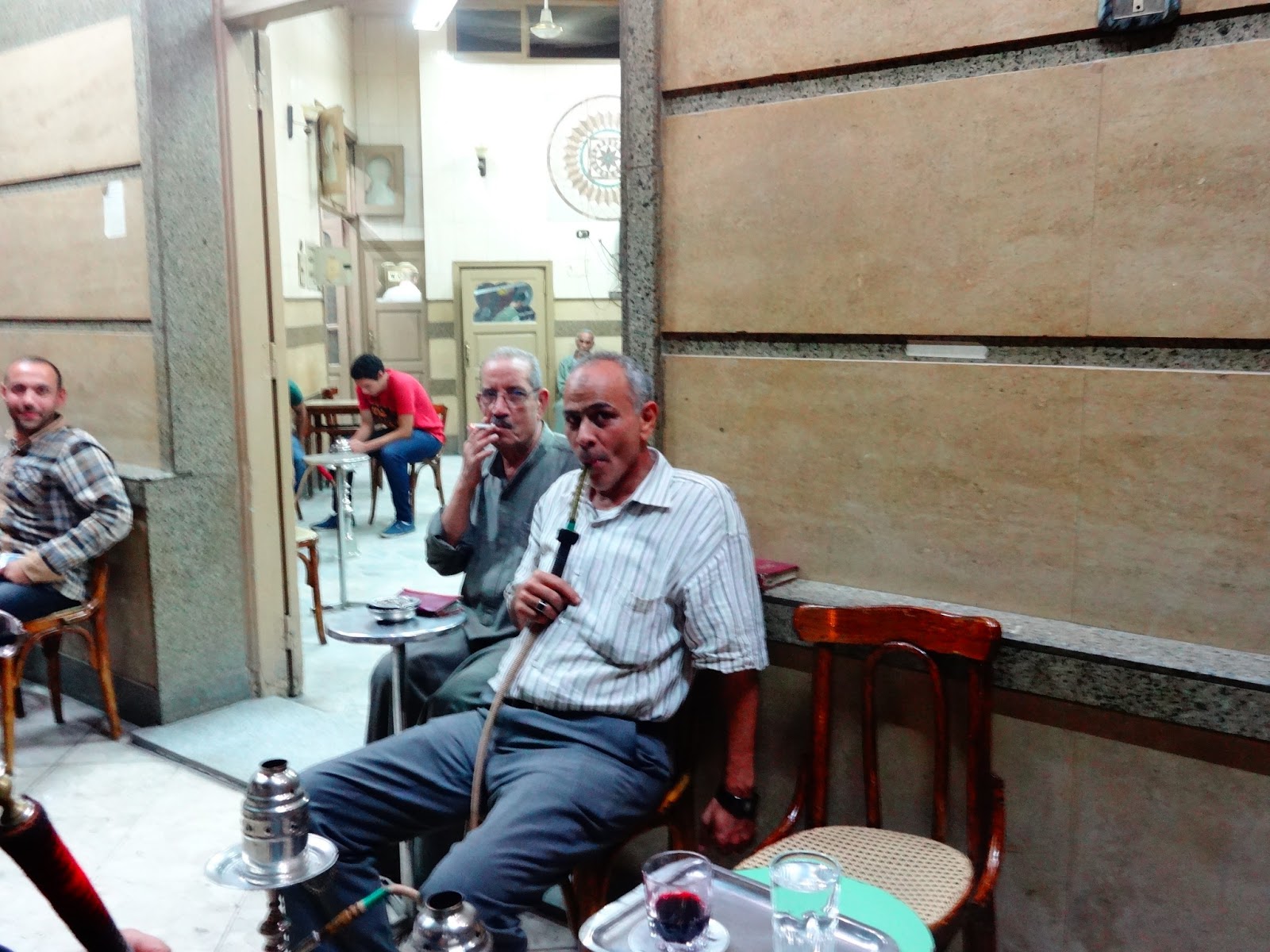
When we arrived at the cafe, we were given a great parking spot right in the front and by the time we sat down, they already had three hookahs ready for us.  Magdy gave his hellos to everyone and introduced us around.  Sure enough - the culture is very tight and everyone knew everyone.  And apparently, this is a pretty exclusive crowd.  Mostly doctors and successful businessmen, Magdy informed us that they all meet up at 7:00 am every morning, smoke some shisha, get to work, and return later to meet.  And if he misses more than a few days, he gets the "are you alright" phone call.  Takes me back to days of being a bar owner and the closeness we felt with our loyal customers.  A splendid thing indeed.

Magdy informed us that this particular cafe had been open since the 1950 as a family business.  He has been coming here for 15 of those years.  Apparently the owner has been offered upwards of 6 million Egyptian Pounds for the business,  but will not give it up as it's history is too rich for him.  He allowed me to take a photograph, that is him above the picture of the coals.  A very nice and cheerful fella.  

Then came the Turkish coffee, then an unreal hibiscus juice, followed by a mint tea.  I asked for a mango and Magdy promised that we'd stop by a place that serves the best mango juice in town.

But for now, it was the Tombac.  The service of Tombac is very different from that of the shisha service I'm accustom to.  Where the coals get replaced every now and then with the molasses/glycerine blend, the entire "stone" is replaced periodically with the Tombac.  You can imagine the labor that goes into it and the job of keeping a ton of bowls packed and ready to go at all times.  Add to that the heat that you have to endure pulling entire bowls of hot coals and trying to balance them on a mound of tobacco.  More than once I saw these hot colas fall on our server's hands and not once did he flinch.  Them are some tough hands.

We were able to take some great shots with the staff and I was pleasantly amused when they all gave the Legendary Thumbs Up. Of course I believe they were the ones being amused at my goofy expression of affirmation, but what the heck.

Overall ,the Tombac was a magnificent treat.  Certainly not an everyday smoker for moi, as I still can only handle the "for girls" version as an everyday smoker.  However, I definitely want to bring the experience back to the States and share with some good folks at home.  Until then, please stay tuned for tomorrow's adventure at the Khan El Khalili.  Cheers!    


Tuesday, June 11, 2013

Testing Some Home-Made Sheesha Flavors

The future lingers, the possibilities ever-grow, and the ideas continue to evolve into creative realities.

When we discussed importing hookahs into the United States, we also talked about trying to import our own brand of shisha to smoke out of said hookahs.  Somewhere along the line, the idea was thrown at me to actually create the shisha ourselves.  I remember the night, I remember the discussion, and I remember the person who gave me the idea (thank you Sarahrose).  I couldn't sleep that night.  Going over all of the tangents and adventures we could get into with this idea was greatly inspiring.

Ordering tobacco is no easy process.  I had no idea prior to this venture that there are 5 million types of tobacco grown right here in the US of A and they all offer a great variety of flavors and uses.  Unfortunately, I had no idea where to start.  What I did know was that we wanted to start with a whole leaf, cut it down ourselves, and complete the whole process ourselves, by hand.  The long, arduous process of cutting, mixing, and rubbing your fingers to get feeling back into them.

Making sheesha is pretty simple.  The ingredients are fairly easy to acquire and the process is more than enjoyable.  If you like cooking, you'd like making sheesha.  The recipe includes a mix of tobacco, molasses, honey, vegetable glycerin, and whatever flavors you want to flavor your smoke with.  Mix to your liking and smoke away.  It's that simple (pretty much).

For my first batch of sheesha, I wanted a very strong tobacco.  I figured that it nothing else, I could get the process of washing the leaves several times down to a science and learn as much about the dissolution of color and aroma from the washing.  I also wanted
to stick to some fairly simple flavors, so I rounded up some vanilla extract and some mint extract.  To start, this should at least be a decent learning tool.

I figured on making a mint, a mango, a vanilla, and a autumn type mix that was going to be my unique blend that I could toy with and see what happens.  My plan is to perfect that mix before Fall actually rolls around.

For the mint, I have been growing several mint plants at the casa and with the recent rains, they have been growing considerably and have some beautiful leaves ready to pick.  Big aroma and massive minty mouth feel on the these plants, so I'm really looking forward to the final product is able to sit and incorporate for a few weeks.

For the mango, I simply peeled a mango, cut it up, pureed it, and threw it in the mix.  Although it didn't provide the flavor of an extract, it helped the consistency and I think a good mix of both is the way to go.

My Autumn mix, which I simply called "spice" is a very aromatic blend of pumpkin, cinnamon, nutmeg, vanilla, and a few other flavors.  On the nose, it is brilliant.  The flavor is somewhat overpowered by the Connecticut Broad Leaf, but that'll easily be fixed by some lighter tobacco.

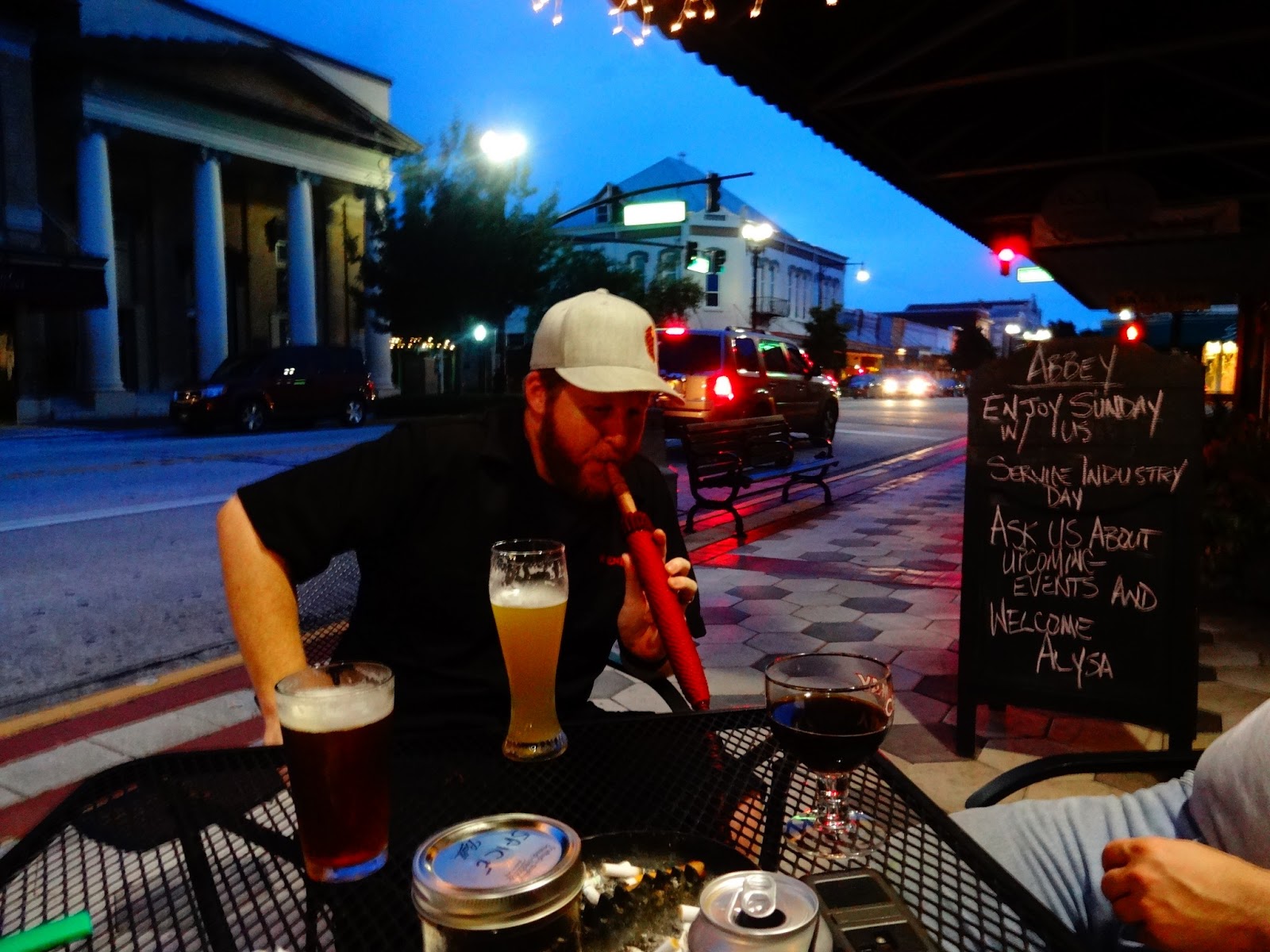
For a first batch, I think I definitely got the mixes down.  Although the tobacco turned out a tad overpowering, we got some great smokes, nice balance, and good clouds from the sheesha.  I was able to share with several folks at Abbey in DeLand and Mermaid Juice in Mount Dora and get some great feedback.  The Autumn mix went over especially well and I mixed up a 25/75 mint-mango that is turning out really good.

In the long term, we're talking about utilizing the Connecticut Broad Leaf to create some middle eastern style flavors, incorporating regional spices to accompany the stronger flavors of the tobacco.  For now, it's off to Egypt tonight for a few weeks and a chance to smoke some Tombac on Thursday.  Reviews to follow.  Cheers!